
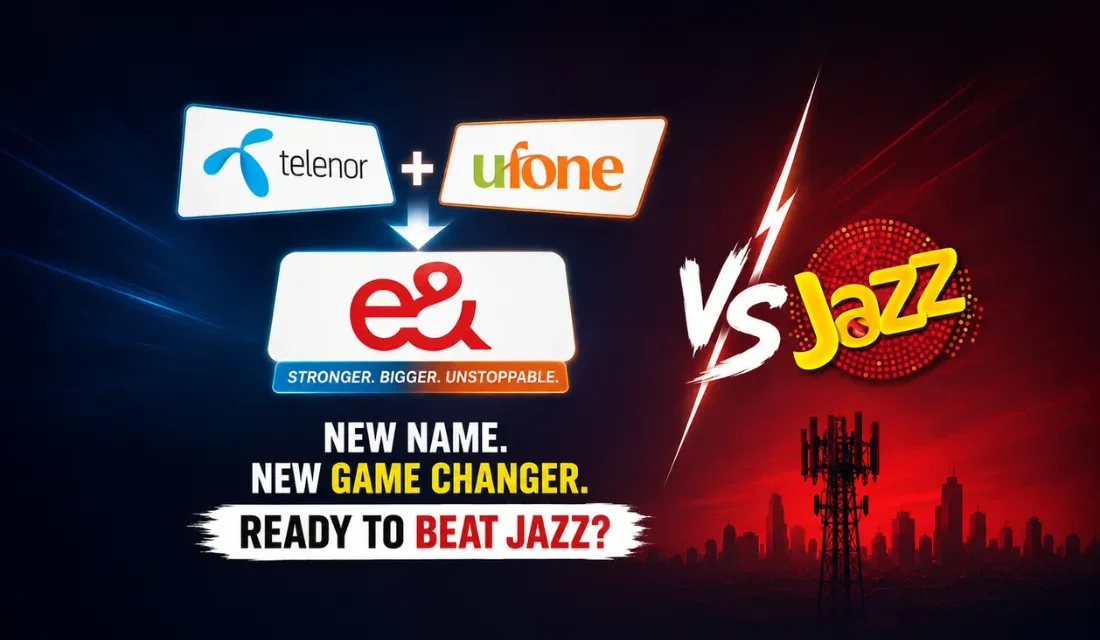
Telenor-Ufone Merger, e& Rumors, And Why Jazz May Finally Face Real Competition
Pakistan’s telecom industry could be heading toward its biggest shake-up in years.
Back on January 1, 2025, Telenor Group officially announced that it would sell Telenor Pakistan to PTCL, which operates under the UAE-based technology group e&. Since then, the deal has slowly moved toward completion, and by late 2025, the acquisition process was officially finalized.
Now the interesting part starts.
Industry rumors strongly suggest that Telenor Pakistan and Ufone could eventually operate under a single unified e& branding strategy in Pakistan. While there is still no official confirmation about the final consumer-facing brand name, discussions around “e& Pakistan” have become increasingly common across telecom circles.
And honestly, if this transition happens properly, Pakistan’s telecom competition could change completely.
The Biggest Threat Jazz Has Faced In Years?
For years, Jazz has comfortably remained Pakistan’s largest telecom network. But the merger between Telenor Pakistan and Ufone could create something Pakistan has not seen in a long time: A genuinely powerful second competitor.
According to recent PTA market data:
- Jazz currently controls around 36.8% of Pakistan’s mobile subscriber market
- Zong sits at around 26.5%
- Telenor holds roughly 21.4%
- Ufone has grown close to 14.9%
Individually, Ufone and Telenor have struggled to seriously challenge Jazz. But combined? That changes the equation entirely.
Together, Ufone and Telenor could potentially cross 35% market share, placing them almost neck-and-neck with Jazz in total subscriber strength. Based on PTA-linked estimates, the combined customer base could exceed 70 million users, which is massive.
Why Users Might Actually Benefit
One major reason many users still prefer Ufone and Telenor is simple: Their packages are usually cheaper. Across social media and local telecom discussions, Jazz is increasingly criticized for becoming the most expensive network in Pakistan, especially for internet bundles and monthly packages.
Meanwhile:
- Ufone often competes aggressively on affordability
- Telenor historically focused on budget and rural users
- Jazz positioned itself as the premium nationwide network
If the merged network combines:
- Telenor’s infrastructure,
- Ufone’s pricing strategy,
- and PTCL/e& investment backing,
Then Jazz could finally face pricing pressure for the first time in years. And that matters because Pakistan’s telecom market has increasingly become expensive while service quality improvements have remained inconsistent.
But There Is Another Problem For Jazz and Zong
Even if the Ufone-Telenor merger becomes successful, Jazz may still face another major threat from a completely different direction. Zong has been aggressively pushing its 5G expansion and infrastructure upgrades.
In March 2026, Zong officially announced its commercial 5G rollout across more than 16 cities in Pakistan, alongside plans to deploy over 1,000+ 5G sites nationwide during 2026.
The company has also maintained strong technological partnerships through its Chinese parent company ecosystem, especially around telecom infrastructure and 5G deployment capabilities.
That gives Zong a serious advantage:
- Stronger backend infrastructure,
- Early 5G momentum,
- Potentially cheaper equipment deployment compared to competitors.
Pakistan’s 5G Race Is Finally Becoming Serious
For years, Pakistan’s telecom companies mostly competed on package prices, coverage, and social bundles. But now the industry is entering a completely different phase. The next telecom war will likely revolve around:
- 5G coverage
- Network stability
- Fiber integration
- Cloud services
- Enterprise infrastructure
- AI-driven telecom systems
And right now:
- Jazz still leads in overall market dominance
- Zong appears strongest in aggressive 5G momentum
- Ufone + Telenor could become a pricing powerhouse after integration
For the first time in years, Pakistan’s telecom market actually looks unpredictable.
The Biggest Challenge For The New Merged Network
Merging telecom companies sounds exciting on paper, but the real-world execution is extremely difficult.
The new combined network will still need to solve:
- Tower integration,
- Spectrum optimization,
- Customer migration,
- Service quality consistency,
- Branding confusion.
Because right now, Ufone and Telenor users often complain about inconsistent coverage and internet performance in different cities. If the merged company fails to improve service quality, subscriber numbers alone will not matter much.
So Who Is Winning Right Now?
At the moment:
Jazz
Still has the strongest nationwide dominance, brand recognition, and network trust.
Zong
Looks the most aggressive in future-focused 5G expansion.
Ufone + Telenor
It could become the strongest value-for-money competitor if the merger is executed properly. And honestly, that might finally be good news for Pakistani users.
Because real competition usually means:
- Better packages,
- Improved infrastructure,
- And lower prices.
Something Pakistan’s telecom market badly needs right now.

